



Welcome back to Taste of Truth Tuesdays.
Social media is one of those topics everyone thinks they’ve already heard enough about. We know it’s distracting. We know it’s addictive. We know we probably spend too much time on it.
But I think the more interesting question is what it’s actually doing to us.
Not just our attention spans, but our identities. The way we compare ourselves to others. The way we construct a public self. The way our opinions, beliefs, and even our sense of belonging are shaped by algorithms we rarely think about.
So today, I want to dig into some of the psychology behind social media, why these platforms are so effective at keeping us engaged, and what happens when our online selves start bleeding into our offline ones.
Social Media Was Never Just Connection
Social media started as a way to stay connected. At least, that was the promise.
I was one of those early Facebook users back in 2006 when you still needed a college email address to get in. At the time, it felt pretty harmless. You’d connect with classmates, post a few photos from the weekend, update your relationship status when things got serious (or dramatically remove it when they didn’t), and keep up with friends after graduation.
It felt like a tool. Something you used.
Nobody was talking about algorithms, engagement metrics, dopamine loops, personal brands, parasocial relationships, or attention economies. We certainly weren’t debating whether social media was reshaping childhood, influencing elections, fueling ideological movements, or altering how people form identities.
But somewhere along the way, these platforms stopped feeling less like tools and started feeling more like environments. Places where we spend our time, build our identities, test our beliefs, seek validation, join communities, argue about politics, find meaning, lose meaning (like deconstructing from Christianity), and sometimes lose ourselves.
Most conversations about social media focus on screen time. Are we spending too much time online? Is it bad for our attention spans? Should we all touch more grass?
Those questions matter, but I don’t think they’re the most interesting ones.
The bigger question is what happens when some of our most basic human needs get routed through algorithms.
The need for belonging. The need for approval.
The need for status. The need for identity.
The need to feel seen.
Because social media isn’t just changing how we communicate. It’s changing how we relate to ourselves, to each other, and to reality.
It influences what we pay attention to. What we reward. What we fear. What we believe. Who we trust. Who we distrust. Which ideas spread. Which ideas get punished. Which communities thrive. Which communities fracture.
And it does all of this while convincing us we’re simply scrolling.
This isn’t a story about technology ruining humanity.
It’s a story about what happens when powerful technology collides with very old human psychology.
We’ll look at the science behind why these platforms are so difficult to put down. We’ll explore how social media shapes identity, belonging, and group behavior. We’ll talk about loneliness, comparison, mental health, ideological recruitment, children growing up in phone-based childhoods, and what it might look like to reclaim some of our attention from systems designed to capture it.
Because the question is no longer whether social media affects us.
The question is how much.
The Science Behind the Scroll aka The Attention Economy
Before we talk about loneliness, mental health, or why so many people feel trapped in a cycle of checking, scrolling, and comparing, it’s worth understanding why these platforms are so effective in the first place.
If social media were simply boring, none of this would matter.
The reason social media has become such a powerful force in modern life is because it is exceptionally good at capturing and holding human attention. That’s not necessarily because tech executives are evil masterminds plotting society’s downfall. It’s because attention is the business model. Most social media companies make money through advertising, which means their success depends on keeping people (like me and you) engaged for as long as possible. The longer you stay, the more ads you see. The more ads you see, the more revenue they generate.
In other words, social media companies aren’t primarily selling connection. They’re selling access to your attention.
To understand why that works so well, we have to talk about dopamine. Unfortunately, dopamine has become one of the most misunderstood chemicals in pop culture. It’s often described as the brain’s “pleasure chemical,” but researchers now understand the story is much more complex. Dopamine plays a major role in motivation, anticipation, learning, and reward prediction. It helps your brain identify what might be worth paying attention to and pursuing in the future.

Social media platforms are remarkably effective at tapping into this system.
Every notification, direct message, comment, share, follow, or like acts as a potential reward. The important word here is potential. The reward isn’t guaranteed. You don’t know whether someone responded. You don’t know whether people liked your post. You don’t know whether there’s something exciting waiting for you when you open the app.
That uncertainty turns out to be incredibly powerful.
Behavioral psychologists have known for decades that variable rewards are often more compelling than predictable ones. Slot machines operate on the same principle. If a machine paid out every fifth pull, people would quickly lose interest. What keeps people pulling the lever is not knowing when the reward is coming.
You check your phone because there might be something waiting for you. Maybe a friend responded. Maybe your post is getting attention. Maybe there’s breaking news. Maybe someone agrees with you. Maybe someone is arguing with you. The uncertainty keeps you checking because the next reward could always be one refresh away.
But social media goes beyond simple reward mechanisms because the rewards themselves are social.
Human beings evolved in small groups where belonging mattered. Reputation mattered. Cooperation mattered. Being accepted by the tribe wasn’t merely emotionally satisfying; it often had direct implications for survival. Our brains evolved to pay attention to social information because social information was important.
Who likes me?
Who doesn’t?
Who agrees with me?
Who is paying attention to me?
Where do I fit within the group?
Those questions are ancient. Social media simply delivers an endless stream of opportunities to ask them.
The result is that many of us now spend our days immersed in a constant flow of social signals. We are tracking reactions, opinions, trends, controversies, status markers, and group dynamics at a scale no previous generation has ever experienced. Our ancestors may have worried about what a few dozen people thought of them. We now have access to the thoughts, opinions, accomplishments, vacations, political views, parenting choices, workout routines, and life updates of hundreds or even thousands of people every single day.
The human brain was never designed for that volume of input.
Researchers have increasingly linked heavy social media use with attention fragmentation, compulsive checking behaviors, sleep disruption, anxiety, and difficulties sustaining focus. Many people report struggling to read long-form books, sit quietly with their thoughts, or engage deeply with a single task without feeling the urge to check their phones. While social media is not the sole cause of these trends, it has undeniably become one of the most powerful competitors for our attention.
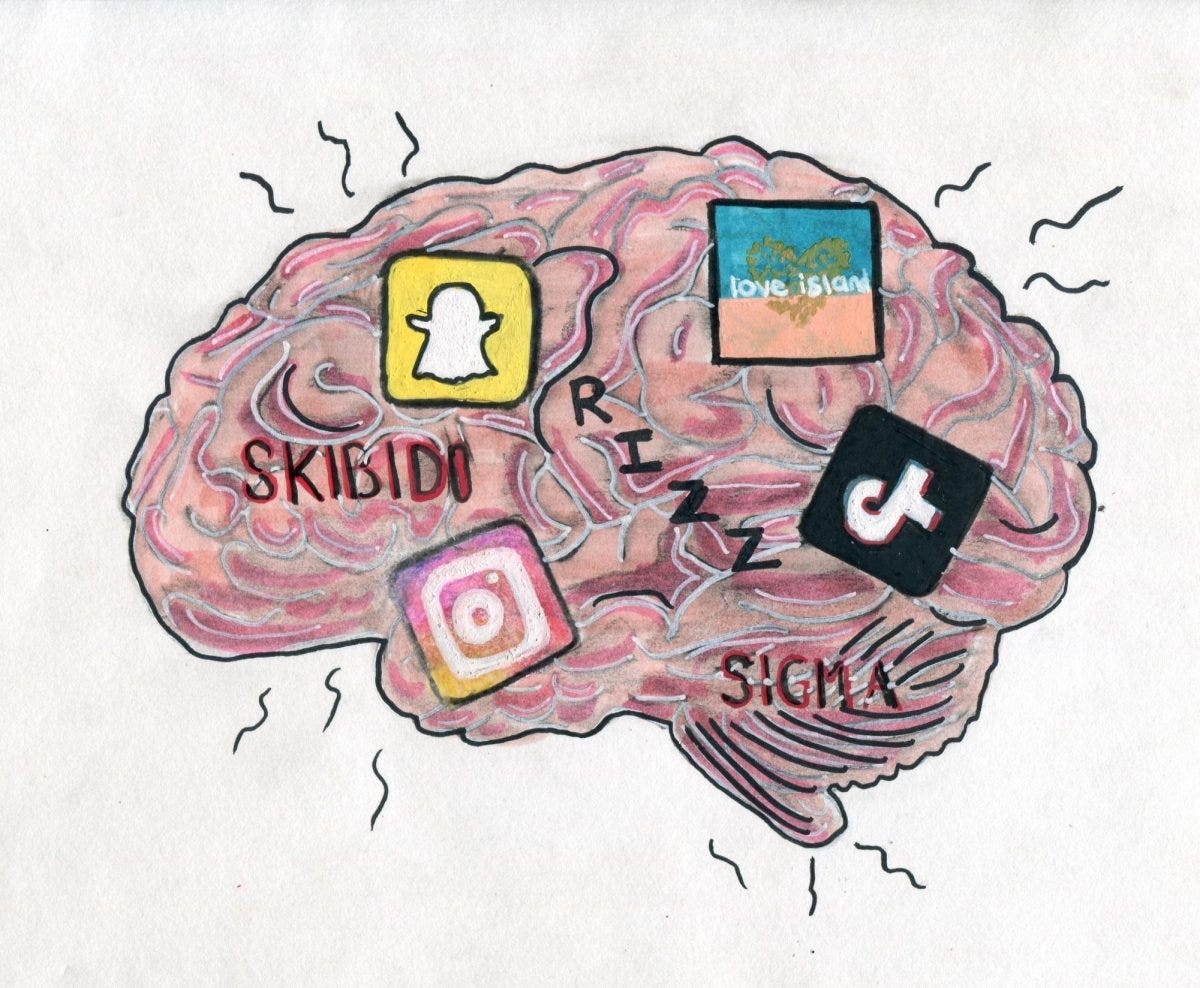
Perhaps this is why the term “brain rot” resonated so strongly when it exploded online. It’s not a clinical diagnosis, but it captures something many people intuitively recognize. The feeling of consuming enormous amounts of information while retaining very little of it. The sense that your attention is scattered across a hundred different conversations, controversies, headlines, and updates. The strange experience of spending hours online while feeling mentally overstimulated and oddly unsatisfied at the same time.
What’s fascinating is that none of this requires a conspiracy. Social media platforms don’t need to force us to participate. They simply align themselves with some of the most powerful drives human beings possess: curiosity, novelty, belonging, status, validation, and social connection.
The technology may be new. The psychological vulnerabilities it exploits are not.
And once we understand that, we can begin to explore something even more interesting: what happens when our need for belonging becomes intertwined with our online identities.
“Our brains are more like lawyers arguing a case than scientists seeking truth.” Jonathon Haidt
The Belonging Machine
If social media only affected our attention spans, that would be concerning enough.
But attention is just the beginning.
What makes social media so powerful is its ability to satisfy one of the deepest human needs we possess: the need to belong.
Most of us like to imagine that our beliefs are carefully chosen. We picture ourselves objectively evaluating evidence, weighing competing arguments, and arriving at rational conclusions. Yet decades of research in psychology suggest that human beings are not nearly as detached or objective as we would like to believe. We are social creatures. We care about belonging, status, reputation, acceptance, and connection. Those needs often shape what we believe far more than we realize.
In many cases, belonging comes before belief.
We like to think we join communities because we agree with their ideas. More often, we find a community that makes us feel seen, understood, valued, or purposeful, and then gradually absorb the worldview that comes with it.
Social media has accelerated this process in ways that would have been difficult to imagine even twenty years ago.
At any moment, someone can find thousands of people who share their interests, frustrations, fears, political views, religious convictions, health concerns, identities, or personal struggles. In many ways, that’s one of the great strengths of the internet. People who once felt isolated can find support, information, and community. Ideas can spread across enormous distances. People can discover they are not alone.
But the same mechanisms that help people find community can also make them vulnerable to manipulation.
Over the years, I’ve become increasingly fascinated by how similar certain groups can look beneath the surface, even when their beliefs appear completely different. High-control religions. MLMs. Certain wellness communities. Political movements. Conspiracy circles. Online activist spaces. Even some corners of cult recovery culture.


There is frequently a strong sense of purpose. A compelling explanation for what’s wrong with the world. A clear distinction between insiders and outsiders. Shared language. Shared symbols. Shared narratives. Shared enemies. A sense that those inside the community possess a deeper understanding than those outside of it.
Most importantly, there is belonging.
And once belonging becomes intertwined with identity, questioning the group’s assumptions becomes much more difficult.
Because now the risk is not simply being wrong.
The risk is losing your community.


Social media amplifies these dynamics by rewarding certainty, outrage, moral conviction, and group loyalty. Nuance tends to spread more slowly than certainty. Ambivalence rarely goes viral. The content that generates the strongest engagement is often the content that offers the clearest villains, the simplest explanations, and the strongest emotional reactions.
What begins as a conversation can become an identity.
What begins as an identity can become a community.
What begins as a community can become a lens through which every new piece of information is interpreted.
I’ve watched this happen repeatedly across completely different domains.
I’ve seen it in religious communities, New Age and wellness culture.
I’ve seen it in political movements on both the left and the right.
Sure, the specific beliefs change, but I’ve grown to notice the pattern… the underlying human needs often remain remarkably similar.
People want:
meaning
certainty
purpose
belonging
I think most of all, we want to feel part of something larger than themselves.
None of those desires are inherently bad. In fact, they’re deeply human. The problem arises when belonging becomes contingent upon agreement, when disagreement becomes moral failure, and when curiosity is replaced by conformity.
Substack is a fascinating example because it doesn’t feel like traditional social media. It feels slower, more thoughtful, more intellectual. Instead of dance trends and viral challenges, people are writing essays, sharing research, building audiences around ideas, and having long-form conversations.
And yet the same dynamics still exist.
Substack has its own status economy. Recommendations, Notes, paid subscriptions, comment sections, private chats, and subscriber communities can create a powerful sense of being inside the room where the “real conversation” is happening. Sometimes that’s wonderful. It allows independent writers and niche communities to thrive in ways that weren’t possible before.
But people rarely subscribe only to information.
They are also subscribing to a lens. Like I said earlier… a worldview. Perhaps a shared suspicion. Or a shared moral framework…. sometimes even a shared enemy.
As scholars who study online communities have observed, digital spaces don’t merely transmit information. They help create what are sometimes called “networked publics”—communities where identity, reputation, audience, and belonging are constantly being negotiated in public view.
The result is that readers can become attached not just to ideas, but to entire communities built around those ideas.
And once that happens, disagreement can begin to feel less like intellectual tension and more like social betrayal.

To be clear, this isn’t a criticism of Substack specifically. The same dynamic exists on Instagram, TikTok, YouTube, Reddit, Facebook, X, Discord servers, podcasts, churches, political organizations, and countless other human communities.
This is not a social media problem as much as it is a human problem.
Social media didn’t create tribalism. Human beings have always formed tribes.
What social media did was remove nearly every barrier that once limited how quickly tribes could form, reinforce themselves, and spread.
The result is a world where identities form faster, communities form faster, ideas spread faster, and social pressure operates at a scale our ancestors never had to navigate.
And perhaps most importantly, it creates an environment where many people begin confusing agreement with truth, certainty with wisdom, and belonging with understanding.
That’s a difficult trap to recognize when you’re inside it. Trust me. I’ve fallen into it myself.


Visibility Is Not Intimacy
What interests me most, though, is not simply whether social media affects mental health. It’s how social media has changed our understanding of connection itself.
I noticed this most during my years as a military spouse. We moved frequently, started over repeatedly, and spent long stretches of time away from family and established community. There were seasons when my husband was working constantly, I didn’t know many people locally, and most of the relationships I cared about existed hundreds or thousands of miles away. During those years, social media felt less like entertainment and more like a lifeline.
Through Facebook and Instagram, I could keep up with everyone’s lives. I knew who got married, who had babies, who started businesses, who changed careers, who was traveling, and who seemed to be thriving. I knew far more about the people in my social orbit than would have been possible for almost any generation before us.
And yet I was lonely.
That contradiction bothered me for years because it didn’t make sense. How could I feel informed about so many people while simultaneously feeling disconnected from them? How could I know so much about their lives and still feel as though something important was missing?
Eventually, I realized that knowing about someone’s life and being part of someone’s life are not the same thing.
One of the questions I ask myself now is this: Did I know about their vacation before they posted the beach picture?
It’s obviously not a perfect test. Not every close friendship requires constant communication, and not every meaningful relationship involves sharing personal updates in real time. But I’ve noticed that some of the people I once felt closest to online were people I hadn’t actually spoken to in months or even years. I knew what they chose to share publicly. They knew what I chose to share publicly. We had access to information about each other, but we weren’t necessarily involved in each other’s lives.
For most of human history, those two things were closely connected. If you knew intimate details about someone’s life, it was usually because you actually knew them. Today, information and relationship have become increasingly separated. I can know what someone ate for breakfast, where they vacationed, what political opinions they hold, how their children are doing in school, and whether they recently renovated their kitchen without having any meaningful role in their life whatsoever.
Social media gives us an unprecedented amount of visibility into one another’s lives, and I think our brains sometimes mistake that visibility for intimacy.
This isn’t because people are foolish. It’s because we’re operating in a social environment that is historically unprecedented. Never before have human beings had this much access to one another’s experiences, opinions, accomplishments, struggles, and daily activities. Our ancestors knew the people in their village. We know hundreds or thousands of people simultaneously, yet many of us struggle to identify who we would actually call in a moment of crisis.
What makes this especially tricky is that social media often provides just enough of the feeling of connection to keep us coming back. A like, a comment, a story reaction, or a quick exchange can create a genuine sense of social engagement. Sometimes those interactions are meaningful. Sometimes they are expressions of real care. But they can also become substitutes for the slower, less efficient work of building actual relationships.
A friend who notices you’re struggling before you post about it. A neighbor who brings over soup when you’re sick. A phone call that lasts two hours. A difficult conversation that deepens trust rather than performing it. These experiences nourish us differently than scrolling through updates from people we haven’t spoken to in years.
I eventually had to admit that during some of my loneliest seasons, I wasn’t really reaching out to people. I was scrolling through them. I wasn’t cultivating community so much as maintaining awareness. I wasn’t participating in relationships as much as I was observing them.
Those are not the same thing.
Perhaps that’s one reason loneliness continues to rise despite our unprecedented connectivity. We know more about one another, yet many of us feel less known ourselves. The promise of social media was connection, but connection turns out to be more demanding than information exchange. It requires presence, reciprocity, vulnerability, and time.
Visibility, it turns out, is not intimacy.
And once we begin recognizing that distinction, some of the biggest fears keeping us tied to these platforms start to look very different.
Why do I feel so empty? Why do I still feel lonely after a scroll session?
The Fears That Keep Us Scrolling
One of the ideas that stuck with me from Carly Burr’s The Social Media Shift is that many of us stay attached to social media not because we genuinely enjoy it, but because we’re afraid of what might happen if we step away. (FOMO)
I’ve had that fear myself.
Not because I thought Instagram was making my life better. Not because I loved spending hours scrolling. But because social media had become woven into so many parts of modern life that leaving felt almost irrational. How would I keep up with people? How would I know what was happening? What opportunities would I miss? Would I slowly disappear from everyone’s lives?
The interesting thing is that many of those fears sound reasonable on the surface.
Until you start examining them.
One of the biggest fears is the fear of losing connection. Social media platforms have spent years positioning themselves as the infrastructure of modern relationships. They are where birthdays are remembered, life updates are shared, invitations are posted, and conversations happen. It’s easy to begin believing that these platforms are holding our social lives together.
But when I started looking more closely at my own relationships, I noticed something uncomfortable. The people who mattered most were rarely the people I interacted with most online. My closest friendships were sustained through phone calls, text messages, visits, shared experiences, difficult conversations, and the countless small moments that never appeared on a feed.
The relationship existed independently of the platform.
The platform simply made the relationship more visible.
That’s an important distinction to make here.
A second fear is the fear of losing people altogether. Social media allows us to maintain awareness of an enormous number of relationships simultaneously. Former classmates, old coworkers, distant relatives, people we met once at a conference ten years ago. We can watch their lives unfold in real time without ever speaking to them.
For a while, I thought this represented a kind of connection.
Now I’m less sure.
I’ve started wondering whether some of us carry around hundreds of low-level social obligations that previous generations never had to manage. We remain psychologically tethered to people we no longer know, communities we’ve outgrown, and versions of ourselves that no longer exist. The constant stream of updates creates the impression of closeness while often demanding very little actual participation.

There is something strangely exhausting about keeping track of hundreds of lives while struggling to cultivate depth in a handful.
Perhaps the hardest fear to confront is the fear of missing out.
Social media is exceptionally good at creating the sense that something important is always happening somewhere else. Someone is traveling. Someone is succeeding. Someone is having an experience that appears more meaningful, exciting, productive, beautiful, or significant than whatever you’re doing right now.
The result is that many of us spend large portions of our lives mentally elsewhere.
We’re at dinner thinking about what we should post… I mean if you didn’t post your meal, did you even eat it?
While we are reading a book, we may also be wondering what everyone else is talking about online. We’re constantly aware of the lives of others, not the life we are living.
What surprised me most when I spent time away from social media was the how fast the fear of missing out (FOMO) faded.
The feeling that I needed to know everything softened.
The world kept turning. The very few friendships that mattered remained intact.
Perhaps more importantly, I became more present in my own life.
I noticed things I had been overlooking. Conversations felt less interrupted. Ideas had more room to develop. I spent less time observing other people’s experiences and more time participating in my own.
I don’t think the goal is necessarily to abandon social media altogether. Different people will draw different boundaries. But I do think there is value in questioning some of the assumptions we’ve absorbed about these platforms.
Maybe we don’t need constant access to everyone in order to remain close to the people who matter. And maybe some of what we’re afraid of losing was never really ours to begin with.
Generation Alpha and the Phone-Based Childhood
As I was researching and writing this piece, I kept returning to a simple question.
If fully developed adults struggle with these platforms, what happens when a generation grows up inside them?
Many of us remember a world before smartphones. We remember boredom. We remember getting lost. We remember calling a friend’s house and hoping they were home. We remember riding bikes through neighborhoods, knocking on doors, wandering through woods, building forts, getting into trouble, and figuring things out without documenting every moment for an audience.
Generation Alpha does not have that reference point.
Children born between roughly 2010 and 2025 are the first generation growing up entirely within a digital ecosystem. For them, the internet is not something that arrived during childhood. It has always been there. Smartphones, tablets, streaming platforms, social media, and algorithmically curated content are not innovations. They are simply part of the environment.
Previous generations certainly had technology, but most of us experienced a gradual transition. We spent at least part of our childhood in a world where boredom was normal, face-to-face interaction was unavoidable, and much of social development happened away from screens.
Today’s children are growing up under very different conditions.
Increasingly, researchers are asking whether we’re witnessing not just a technological shift, but a developmental one.
In The Anxious Generation, Jonathan Haidt argues that modern childhood has undergone a dramatic transformation. Rather than growing up in what he calls a “play-based childhood,” many children are now growing up in a “phone-based childhood.” Hours once spent exploring neighborhoods, negotiating friendships, resolving conflicts, taking risks, and developing independence are increasingly being replaced by screen-mediated experiences.
The concern isn’t simply that children are spending time online.
The concern is what they’re not doing while they’re online.
Childhood has always involved learning through direct experience. Children develop social skills by interacting with other children. They develop confidence by solving problems. They develop resilience by encountering manageable challenges and discovering they can survive them.
Many of these experiences are difficult to replicate through a screen.
One concept from Haidt’s work that I find particularly compelling is his description of screens as “experience blockers.” A screen doesn’t merely add a new activity to childhood. It often displaces other activities that have historically played an important role in healthy development.
“When you remove thousands of hours of unsupervised play, real-life social interaction, and physical exploration—and replace it with filtered selfies, infinite scroll, and a feedback loop of online validation—you don’t just rewire childhood. You rewire the brain.”
— Jonathan Haidt, The Anxious Generation
Part of the concern comes down to timing of development. The reward systems of the brain develop long before the systems responsible for impulse control, long-term planning, and emotional regulation fully mature. Children and adolescents are therefore encountering some of the most psychologically sophisticated technologies ever created before many of the cognitive tools needed to navigate them are fully developed.
That doesn’t mean every child with an iPad is doomed, nor does it mean every parent is failing.
I think that’s where conversations about technology often become unhelpful. The goal is not to shame parents. Most parents are trying to navigate an environment that did not exist when they were growing up. There is no historical playbook for raising children in a world where the most powerful companies on Earth are competing for their attention.
Still, I suspect many parents already sense that something has changed.
You don’t need a psychology degree to notice the difference between a child who spends an afternoon building forts, climbing trees, inventing games, and negotiating playground politics versus a child spending the same hours moving between videos, apps, and algorithmically generated content. These activities are not exercising the same skills. They are not creating the same experiences.
It’s the possibility that we are gradually redefining childhood around consumption rather than participation.
Around observation rather than exploration.
Around performance rather than experience.
When I think back to my own childhood, some of the most formative moments were not carefully curated experiences. They were moments of boredom, freedom, experimentation, risk, and discovery. They were the moments adults couldn’t fully control.
Those experiences helped build a sense of independence and competence that no app could have provided.
If social media and digital technology are reshaping childhood, the question isn’t simply whether children are spending too much time on screens.
The deeper question is what experiences those screens are replacing.
Because what is at stake may be much larger than attention spans.
It may be the developmental architecture through which children learn who they are, how they relate to others, and how they engage with the world itself.
When Childhood Becomes Content
The concerns surrounding social media and childhood don’t end with screen time.
They’re now creating it, performing it, monetizing it, and in some cases building entire family businesses around it.
Today, a child can become the center of a personal media empire before they are old enough to fully understand what that means.
Family vacations become content.
Birthday parties become content.
School milestones become content.
Even emotional moments, arguments, disappointments, and vulnerabilities can become content.
The result is a generation of children growing up with audiences.
As I watched the Netflix documentary on Piper Rockelle and the world surrounding child influencers, what struck me wasn’t simply the issue of exploitation, although there are certainly serious concerns there. What struck me was how difficult it becomes to separate childhood from performance when a camera is always present.

Childhood is supposed to be messy.
It’s supposed to contain awkward phases, bad haircuts, embarrassing mistakes, failed experiments, shifting identities, and countless opportunities to try on different versions of yourself before deciding who you want to become. Most of us were fortunate enough to move through those years without a permanent digital record documenting every stage.
Today’s child influencers often don’t have that luxury.
Many are growing up in environments where engagement metrics, audience expectations, sponsorship deals, and personal identity become intertwined from a very young age. They are learning not only how to navigate childhood, but how to navigate public perception simultaneously.
That strikes me as a tremendous psychological burden.
Developmental psychologists have long understood that adolescence is a period of identity formation. Young people experiment with different interests, friend groups, values, and ways of presenting themselves to the world. Much of that process requires privacy. It requires room to fail, change your mind, and evolve without thousands or millions of people watching.
Social media fundamentally alters that environment.
When attention, validation, and financial incentives become attached to a particular online persona, there is a risk that performance begins to crowd out exploration. A child may start asking not simply, “Who am I?” but “What version of me gets the most views?”
That is a very different question.
What concerns me most is that many of these dynamics are becoming normalized. We’ve become accustomed to seeing children accumulate followers, sponsorships, brand deals, and audiences large enough to rival traditional celebrities. What would have seemed extraordinary fifteen years ago now barely registers as unusual.
At the same time, lawmakers and child advocates have begun raising questions about ownership, privacy, consent, and compensation. Several states have introduced protections aimed at ensuring children who generate income through family content creation receive legal and financial safeguards similar to those provided to child actors. The fact that these conversations are happening at all suggests we are only beginning to understand the long-term implications of growing up online.
Perhaps the deepest concern is not simply that children are being watched.
It’s that they may begin watching themselves.
Social media encourages a kind of perpetual self-observation. We learn to see ourselves through the imagined eyes of an audience, evaluating our experiences not only as participants but as potential content creators. For adults, that tendency can be exhausting. For children still developing a stable sense of self, it may be even more significant.
In earlier generations, childhood was largely something you lived.
Today, for a growing number of children, childhood is also something being documented, curated, evaluated, and shared.
We’re still learning what that will mean.
But it seems worth asking whether every moment of childhood is meant to have an audience.

Reclaiming Your Attention
Whenever people talk about social media, the conversation eventually turns toward solutions.
Delete the apps. Turn off notifications. Set screen time limits. Touch grass.
Some of that advice is useful. Some of it isn’t. But I’ve come to think the deeper issue isn’t really about social media itself.
It’s about attention.
What receives our attention shapes our experience of reality. It influences what we think about, what we worry about, what we value, and ultimately who we become. In many ways, attention is one of the most valuable resources we possess, and yet most of us give it away far more freely than we realize.
One of the first things I noticed when I began changing my relationship with social media was how often I reached for my phone without making a conscious decision. Standing in line. Waiting for water to boil. Walking from one room to another. Tiny pockets of boredom that had once been filled with daydreaming, observation, reflection, or simply existing were now being filled automatically with content.
At some point, I started asking a simple question:
What happens if I don’t reach for it?
The answer was surprisingly uncomfortable.
Boredom showed up.
Restlessness showed up.
Loneliness showed up.
Curiosity showed up.
Ideas showed up.
It turned out that social media wasn’t only occupying my attention. Sometimes it was helping me avoid my own thoughts.
One of the most helpful changes I made was resisting the urge to begin and end my day online. Not because there’s something magical about a specific morning routine, but because I noticed a difference in how my days felt. On mornings when I immediately opened social media, my attention was scattered before the day had even begun. Other people’s opinions, accomplishments, low IQ arguments, advertisements, and anxieties entered my mind before I had a chance to decide what actually mattered to me that day.
The difference was dramatic.
I also became more intentional about what I allowed into my digital environment. Social media often encourages us to think about consumption in terms of quantity. How much time are you spending online? Increasingly, I think quality matters just as much. Some accounts consistently left me feeling inspired, informed, or challenged in productive ways. Others left me agitated, anxious, distracted, or trapped in cycles of comparison. Eventually I realized I didn’t owe my attention to every person, topic, controversy, or algorithmically suggested outrage of the day.
Attention is a form of permission.
Not everything deserves access to it.
Perhaps the biggest shift, though, came from spending more time in the physical world.
Gardening helped.
Reading helped.
Long walks helped.
Cooking helped.
Conversations that weren’t mediated through screens helped.
None of these activities produced the immediate stimulation of social media. That was precisely the point. They operated on a different timescale. They required patience. Presence. Engagement with reality rather than endless commentary about reality.
For years I thought social media was competing with books, hobbies, or productivity.
I’m no longer convinced that’s true.
I think social media is often competing with stillness.
And stillness is where many of the things we claim to value actually grow. Creativity. Reflection. Insight. Self-awareness. Meaningful relationships. None of these tend to emerge from an endless stream of notifications and updates.
This doesn’t mean technology is inherently bad. I’m writing this on technology. You’re reading it on technology. The internet has allowed me to learn from people I never would have met and engage with ideas I never would have encountered otherwise.
The goal isn’t rejection.
It’s intentionality.
To decide when technology is serving you and when you are serving it.
To recognize when curiosity is becoming compulsion.
To notice when connection is becoming consumption.
To ask whether an app is helping you engage more deeply with reality or simply distracting you from it.
Perhaps the most important skill we can cultivate in a world saturated with information is not learning how to consume more of it.
It’s learning how to choose what deserves our attention in the first place.
Final Thoughts
Like most powerful technologies, social media is neither entirely villain nor entirely hero.
The challenge is learning how to use it without being used by it.
For me, that has meant becoming more protective of my attention, more intentional about the communities I participate in, and more skeptical of the assumption that constant connectivity is the same thing as meaningful connection. It has meant spending more time creating than consuming, more time participating in life than observing it, and more time asking whether a tool is serving my values or quietly reshaping them.
I don’t think the answer is disappearing into the woods and throwing your phone into a river.
I do think the answer begins with awareness.
Awareness of what these platforms are designed to do.
Awareness of the needs they satisfy.
Awareness of the needs they cannot satisfy.
Because once you begin noticing the difference, you regain something incredibly valuable: the ability to choose.
And in a world increasingly designed to capture your attention, that ability may be one of the most important forms of freedom we have left.
Until Next Time…
Maintain your curiosity, embrace skepticism, and keep tuning in.

Sources and Further Reading
Pew Research Center. “Teens, Social Media and Mental Health.” 2025.
https://www.pewresearch.org/internet/2025/04/22/teens-social-media-and-mental-health/U.S. Surgeon General. “Social Media and Youth Mental Health: The U.S. Surgeon General’s Advisory.” 2023.
https://www.hhs.gov/surgeongeneral/reports-and-publications/youth-mental-health/social-media/index.htmlAmerican Psychological Association. “Health Advisory on Social Media Use in Adolescence.” 2023.
https://www.apa.org/topics/social-media-internet/health-advisory-adolescent-social-media-useHaidt, Jonathan. The Anxious Generation: How the Great Rewiring of Childhood Is Causing an Epidemic of Mental Illness. Penguin Press, 2024.
Twenge, Jean M. “The Sad State of Happiness in the United States and the Role of Digital Media.” World Happiness Report, 2019.
https://worldhappiness.report/ed/2019/the-sad-state-of-happiness-in-the-united-states-and-the-role-of-digital-media/Keles, Betul, Niall McCrae, and Annmarie Grealish. “A Systematic Review: The Influence of Social Media on Depression, Anxiety and Psychological Distress in Adolescents.” International Journal of Adolescence and Youth, 2020.
https://doi.org/10.1080/02673843.2019.1590851Shannon, Holly, et al. “Problematic Social Media Use in Adolescents and Young Adults: Systematic Review and Meta-analysis.” JMIR Mental Health, 2022.
https://mental.jmir.org/2022/4/e33450/Ahmed, Osman, et al. “Social Media Use, Mental Health and Sleep: A Systematic Review.” Journal of Affective Disorders, 2024.
https://www.sciencedirect.com/science/article/pii/S0165032724014265Han, Xu, et al. “Electronic Media Use and Sleep Quality: Systematic Review and Meta-analysis.” Journal of Medical Internet Research, 2024.
https://www.jmir.org/2024/1/e48356/Brady, William J., et al. “Emotion Shapes the Diffusion of Moralized Content in Social Networks.” Proceedings of the National Academy of Sciences, 2017.
https://www.pnas.org/doi/10.1073/pnas.1618923114Rathje, Steve, Jay J. Van Bavel, and Sander van der Linden. “Out-group Animosity Drives Engagement on Social Media.” Proceedings of the National Academy of Sciences, 2021.
https://www.pnas.org/doi/10.1073/pnas.2024292118Burr, Carly. The Social Media Shift.
Council of State Governments South. “From Likes to Laws: State Legal Protections for Child Influencers.” 2025.
https://csgsouth.org/policies/from-likes-to-laws-state-legal-protections-for-child-influencers/Rosher, Jenna, and Kief Davidson, directors. Bad Influence: The Dark Side of Kidfluencing. Netflix, 2025.
https://www.netflix.com/tudum/articles/bad-influence-the-dark-side-of-kidfluencing-release-date-news


